 Askpert
AI Agent Harness: What It Is, and Why Your Agent Needs One
An AI agent harness turns an LLM into a reliable agent. Learn the run loop, tools, memory, and guardrails, plus how to rent a sealed expert as a tool.
On this page
Terms, definedthe jargon, decoded
- LLM
- A large language model, the AI that predicts text behind tools like Claude and ChatGPT.
- AI agent
- An LLM placed in a loop that can take actions (call tools, read results, keep going) until a goal is met, not just chat back.
- Agent harness
- The software layer around the model that runs the loop, calls tools, manages context, and enforces guardrails.
- MCP
- Model Context Protocol. A standard way to expose tools to an agent so the same tool works across different AI clients.
- RAG
- Retrieval-augmented generation. Pulling the few relevant documents into the model so it answers from your facts.
- Tool calling
- The model requests an action in structured form; the harness validates it, runs the real function, and feeds the result back.
- Context window
- A model's short-term working memory. Everything in it costs money and time, so the space is limited.
- Compaction
- Summarizing older turns once the context window fills, so a long run can keep going instead of overflowing.
- Agentic AI
- The broader idea of software that plans and acts on its own, rather than answering one question at a time.
Everyone is building agents right now, and most of the ones that hold up in production owe it less to the model than to the plumbing around it. That plumbing has a name. This post goes from the ground up: what an agent is, why it falls apart without a harness, and how to wire real, protected expertise into one without hand-rolling a knowledge stack. Practitioner-honest, no hype.
Two terms up front, because the rest leans on them. An LLM (large language model) is the AI behind tools like ChatGPT and Claude: you type, it predicts a useful response. An AI agent is that model put in a loop so it can take actions, not only talk back. The harness is what makes the second one work.
What is an AI agent?
An AI agent is a large language model put in a loop that can act. It observes the current state, decides what to do next, calls a tool, reads the result, and repeats until the goal is met or the budget runs out. Three parts matter: a loop, actions, and state that carries forward between steps.
A plain chatbot does none of that. You send a message, it sends one back, and the exchange is over. An agent keeps going on its own. It might read a file, notice a failing test, edit the file, and run the test again, stopping only once it passes. Nobody typed those steps. The loop did.
AI agent vs LLM: the model is not the agent
Worth separating two things people blur together. A large language model is a function: text in, text out, one shot. Ask it something and it predicts a good answer from a single prompt. That is it. No memory of the last call, no ability to run anything, no way to check its own work.
An agent is that model called repeatedly inside a loop, with code around it that executes tool calling, feeds results back, tracks state, and decides when to stop. The LLM is the brain. The agent is the brain plus the machinery that lets it act on the world. Swap in a smarter model and a weak agent is still weak, because most of what makes an agent useful lives in that machinery, not in the raw next-token prediction.
Agentic AI vs AI agents: is there a difference?
Short version: an AI agent is a specific system that pursues a goal through a tool-using loop. Agentic AI is the broader idea, software that plans and acts on its own rather than answering one question at a time.
So "AI agent" names the thing you build and run. "Agentic AI" names the property, the shift from software that responds to software that takes initiative. When a vendor says their product is "agentic," they mean it can decide and act across multiple steps. When they say it "has agents," they mean concrete units doing that work.
You will see both terms used loosely, and that is fine. The distinction that actually pays off is the earlier one: model versus model-in-a-loop.
AI agent examples: what agents actually do
Concrete beats abstract, so here are four, running from everyday to developer. Each one makes the observe, decide, act loop explicit.
Start with a coding agent. You point it at a repo and ask it to fix a failing test. It reads the relevant files (observe), decides a null check is missing (decide), edits the function (act), runs the suite (observe again), sees a second failure, and loops until green. Claude Code and similar tools do exactly this.
A research agent works the same way. You ask it to compare the three leading vector databases on filtering. It searches the web (act), reads the top results (observe), notices it has nothing on one of them (decide), searches again, then writes a summary once it has enough. The cycle is search, read, check coverage, repeat.
A travel assistant shows the pattern outside coding. "Find me a flight under $400 next Friday and hold it." It queries an airline API (act), reads the options (observe), decides none fit under the cap, widens the time window, finds one, books. Each step feeds the next.
A domain agent is where it gets interesting. You ask a specialist question, say a Meta Ads audit, and your agent does not know the answer itself. So it calls an expert tool, waits for the result, and folds that answer into its reasoning. Same loop, except the "tool" is someone else's packaged expertise, which is where Askpert comes in.
Not one of these is a single model call. Each is a cycle of observe, decide, act, observe, and each depends on code around the model doing the calling, the reading, and the stopping. That code is the harness.
Why an AI agent needs a harness
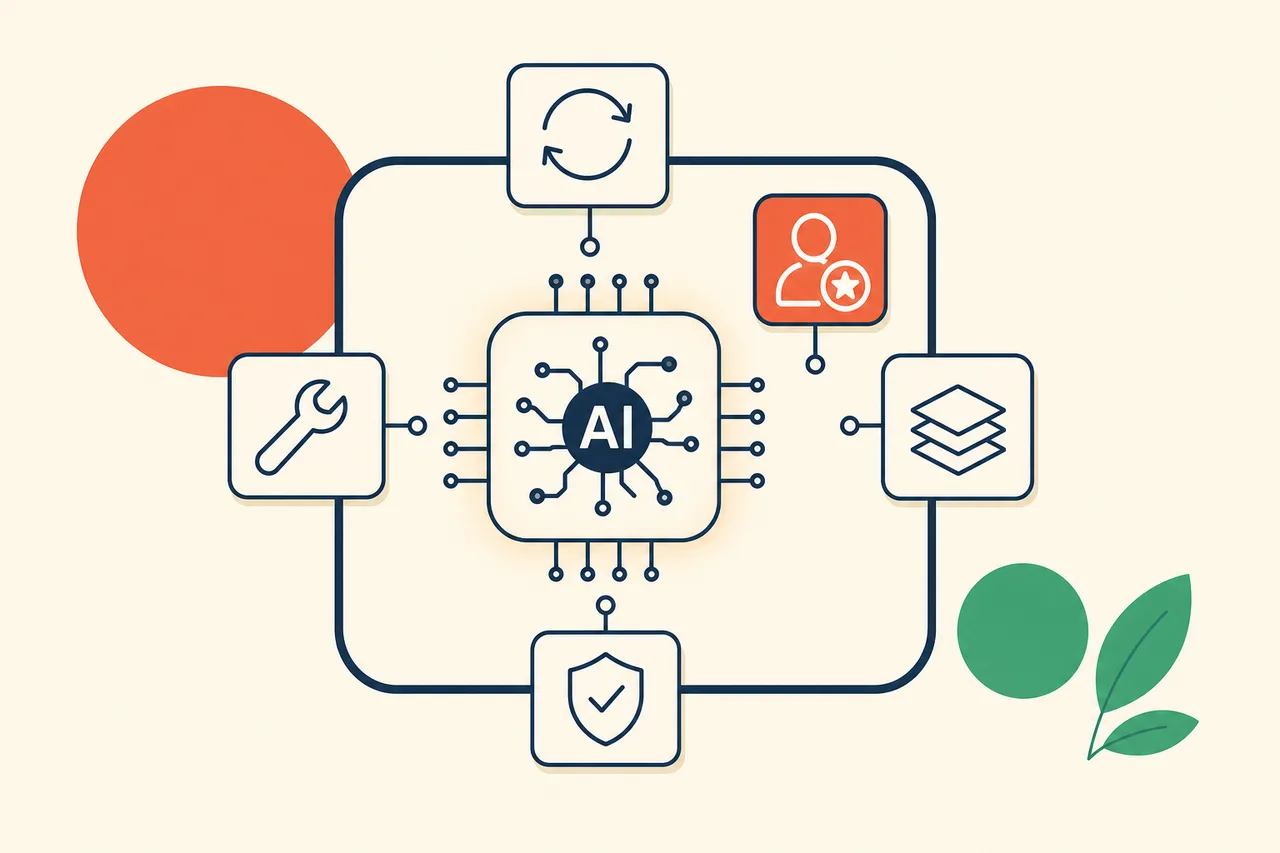
The raw model is just the brain. The agent harness is everything around it that makes an agent work when real users depend on it. Model quality is table stakes now. The frontier models are all strong. The gap between a demo that impresses on a Friday and a system that holds up on a Monday is almost never the model. It is the layer wrapped around it.
Put the same model behind a better harness and you get a better agent. That is not a slogan, it is where the reliability comes from. In practice a builder hits four problems fast, and a smarter model solves none of them:
- Giving the agent the right tools, not every tool.
- Keeping proprietary knowledge available to the agent without pasting it into the prompt where it can leak.
- Not spilling secrets into your logs.
- Not rebuilding a retrieval and knowledge subsystem from scratch for every new domain you touch.
Each section below is one layer of the harness. Together they are the difference between "it worked when I tried it" and "it works."
The run loop and orchestration
At the center is a while-loop. Call the model. If it asked for a tool, run the tool. Append the result to the running context. Feed everything back to the model. Check whether you should stop. If not, go again.
The stop condition is where a lot of production pain hides. You need a clear taxonomy: completed (the goal is met), failed (something broke and retrying will not help), awaiting-user (the agent needs input it cannot get on its own), and budget-exhausted (it hit a turn or cost ceiling). That last one exists for a blunt reason. Without a turn budget, a confused agent loops forever, calling the model over and over, and you wake up to a bill. A flat cap on turns per run, say a hundred, plus a compaction step when context fills, is the boring machinery that keeps runaway cost and infinite loops from happening. Skip it and you learn why it is standard.
Orchestration is also where retries, timeouts, and partial-failure handling live. A tool call times out: do you retry, fail the run, or ask the user? A subtool returns garbage: does the loop notice, or feed the garbage back to the model and compound the mistake? These are not model questions. They are harness questions, and you answer them in code. We published the exact budgets, truncation rules, and timeout discipline our own run loop enforces, numbers included.
AI agent tool calling and why MCP matters
Tool calling is the mechanism that lets an agent act. The model emits a structured request, usually JSON, naming a tool and its arguments. Your harness validates that request against a schema, runs the real function, and feeds the result back as the next turn's input. The model never runs anything itself. It only asks, and your code decides whether and how to run it.
Two things bite people here. First, the schemas have to be strict. Loose or ambiguous tool definitions produce malformed calls, and a model that gets a validation error back often burns turns trying to fix it. Second, more tools is not better. Past a couple dozen tools, most models start picking the wrong one or ignoring options entirely. Curate the tool list per task. A tight set of the right tools beats a sprawling menu every time.
This is where MCP (the Model Context Protocol) earns its place. MCP is becoming the standard way to expose tools to agents in a portable form, so a tool you define once works across Claude, Cursor, and other MCP-aware clients without a bespoke adapter for each. For a builder it means tools become pluggable: you wire in an MCP server and its tools show up in your agent's tool list. That portability is exactly what makes the next idea work, a rented expert can be just another MCP tool your agent calls. The buyer-side wiring is written up in the buyer docs.
Context, memory, and knowledge
What you feed the model each turn is the single biggest lever you have. The model knows only what is in its context window right now. So the harness decides, on every turn, what goes in: the task, the relevant history, retrieved documents, tool results, instructions.
Three jobs live here. Retrieval (RAG) pulls the few relevant chunks out of a large corpus so the model sees what it needs and not the whole haystack. Restraint is the point: stuffing the window measurably degrades accuracy. Memory carries facts and decisions across turns so the agent does not repeat itself or forget what it already learned. Compaction summarizes older turns when the window starts filling, so the run can continue. The usual move is to trigger it while the window is most of the way full, before it overflows rather than after. Wait too long and you risk overflowing mid-run.
Now the hard part, the one that leads straight to buy-versus-build. You often need the agent to use private or proprietary knowledge (a company's internal SOPs, a consultant's playbook, a curated document set) without pasting that knowledge into the prompt where a buyer or a log could capture it. And you do not want to stand up a fresh retrieval pipeline, embedding store, and eval set for every new domain. Building that once is real work. Building it five times is a project you never signed up for.
Guardrails, permissions, and not leaking secrets
Guardrails are the rules that keep an agent from doing something it should not: input validation, output checks, permissioned tool access so the agent can read but not delete, rate limits so a loop cannot hammer a downstream API. Standard defensive engineering, applied to a system that acts on its own. The attack that motivates much of it is prompt injection, where whatever the agent can reach becomes the attack surface.
One rule deserves its own paragraph, because it is the one teams learn the hard way. Never log private prompts, user messages, or retrieved chunks verbatim. A single logger.info(prompt) in a hot path quietly ships proprietary content into Datadog, Sentry, or wherever your logs land, and now the secret sits in a third-party system you do not fully control. Redact or skip that content in every logging, tracing, and observability path, not only the one you remembered. That discipline is baked into how we run Askpert: private assets never appear in responses, error payloads, or logs. It is a rule worth copying into any agent you build, whether or not you ever touch Askpert.
Evaluation
You cannot improve a harness you do not measure. Evaluation is the layer that tells you whether a change made the agent better or just different. In practice that means a regression suite of representative tasks you re-run on every change, plus some form of trajectory checking: did the agent take a sane path, not just land on a plausible final answer. Run each task more than once while you are at it: an agent's reliability is a spread across repeated runs, not a single pass. LLM-as-judge scoring helps here, grading outputs against a rubric so you are not eyeballing every run by hand. It is the least glamorous layer and the one that separates an agent you can safely change from one you are afraid to touch.
AI agents framework vs building your own harness
Frameworks exist to give you the loop for free. LangGraph, the OpenAI Agents SDK, CrewAI, AutoGen, and the Claude Agent SDK all hand you orchestration primitives: a run loop, tool-calling plumbing, state passing, sometimes multi-agent coordination. Worth using. You should not hand-write the while-loop in most cases.
But be clear on what a framework is. A framework is one way to build the harness, not the harness itself. The harness is the whole runtime layer around your model, and a framework covers the scaffolding part of it. It does not cover the two layers that are actually hard: the right tools for your problem, and the domain-knowledge stack (retrieval, documents, evals, and the upkeep of all three) behind those tools. Those you still own.
Buy-versus-build applies per layer, not to the whole thing at once. The loop? Use a framework. The tools generic to your app? Build them. The domain-knowledge layer? That is the one most teams should not hand-roll, because it is expensive to build well and it multiplies with every domain you add. If you want a feel for what packaged expertise looks like before wiring it in, you can see how experts get hired. Which brings us to the product.
How Askpert plugs into your agent harness
Askpert (askpert.dev) is a marketplace where domain experts package private knowledge, prompts, documents, tools, and workflows into protected AI Experts. Your agent calls a rented Expert as a tool, over MCP or the REST API, exactly like any other tool in its list. The difference is what stays hidden.
Rent a sealed expert as one MCP tool
The mechanic is simple. Your agent asks the Expert a question. The Expert runs server-side on Askpert, using its own prompts, documents, and logic. It returns the answer. That is all your agent, your logs, and your users ever see.
The seller's private assets (the system prompt, the uploaded docs, the retrieved RAG chunks, the routing logic, the chain-of-thought) never leave Askpert's servers. They do not appear in your agent's context, your responses, or your logs. The buyer receives the Expert's name, description, input schema, endpoint, an auth token, and the final answer. Nothing underneath. Every Expert endpoint carries authentication and rate limiting from day one, because anti-probing is part of the product, not a setting you remember to switch on. This is the concrete thing a generic "what is a harness" article cannot show you: a real, rentable, sealed expert you call as one tool. The ones live now are in the marketplace.
The MCP consult flow at a glance
You do not need the wire protocol to picture how it runs. The mental model is about five steps. Your agent consults the Expert with an input. The run may come back as still running, so your agent polls for the result (long-running work is normal here, not a sign something is stuck). If the Expert needs more from you, it can pause and ask, your agent replies, and the run resumes. When the run completes, your agent relays only the final answer into its own context and keeps going. Envelope details and status handling are in the docs.
Buy vs build the knowledge layer
Building and maintaining a domain-knowledge subsystem inside your harness (retrieval, documents, evals, and the ongoing upkeep) is a real, recurring cost. Renting a sealed Expert and wiring it in as one MCP tool moves that cost off your plate and keeps the underlying assets protected on someone else's server. That is buy-versus-build for the knowledge layer, the one most teams get the least return from building themselves.
Browse rentable experts at askpert.dev/market and see how to wire one into your agent in the buyer docs.
AI agent harness FAQ
Is an AI agent harness the same as an agent framework?
No. A framework (LangGraph, the OpenAI Agents SDK, CrewAI) is one way to build the harness, giving you the run loop and orchestration primitives. The harness is the whole runtime layer around the model, including the tools, the knowledge stack, guardrails, and evaluation that the framework does not supply.
What's the difference between an AI agent and an LLM?
The LLM is the model: text in, text out, one call, no memory or actions. The agent is that model placed in a tool-using loop, with code that runs tool calls, feeds results back, tracks state, and decides when to stop. Model versus model-in-a-loop.
What is agentic AI vs an AI agent?
Agentic AI is the paradigm, software that plans and acts on its own. An AI agent is a specific system built that way, pursuing a goal through a tool-using loop. One names the property, the other names the thing you run.
Do I need a harness to build an AI agent?
Yes, in practice. Even a minimal agent needs a loop, tool-calling, and a stop condition, and that is already a harness. The real question is not whether you have one, but how much of it you build versus adopt from a framework or a service.
If you are the expert
One turn to the other side of the market. If you are the one with the know-how (the SEO playbook, the ad-audit method, the case-review checklist), that expertise can be the sealed knowledge layer other builders rent into their agents, without handing over the documents, prompts, or logic that make it work. The seller's craft is packaging that know-how into a reusable skill, which we walk through in AI agent skills, explained. You publish an Expert. Buyers call it. They get answers, and your assets stay yours.
Package your expertise into a protected Expert in the Skill Studio, or sign up to start.